

Last week, from February 24-26, the MA House of Representatives rammed through a massive energy omnibus bill. While there were significant improvements over the original version of the bill presented in November, it included program-decimating cuts to Mass Save worse than what was originally proposed. This blog walks through what was in the bill, how 350 Mass and our allies responded, and where we go from here. Thank you to 350 Mass volunteers David Green, Mike Dsida, Jon Grossman, Iselle Barrios, and Mark Dyen, as well as Sierra Club MA Director Vick Mohanka for contributing.
What Happened
Last Tuesday morning, February 24, the MA House Ways and Means Committee released their long awaited redraft of last November's climate rollback bill. Since our movement stopped the bill cold, House Leadership has spent the last few months working on the bill. They have met with industry, activists, labor, and even held an unprecedented four listening sessions for rank and file State Representatives to weigh in. After three months of planning, leadership then decided to rush the bill through in just three days.
After the bill was released at 10 AM, Representatives on the Committee had just 45 minutes to read the 105 page bill and vote on whether it should proceed to the House floor for a vote that Thursday, February 26. This awful process gave legislators minimal time to even understand what they are voting on, much less have an educated position. Some committee members did not even vote, either because they did not have time to read or just didn’t see the bill in time. The final vote saw a slim majority side with the Chair: 18 favorable, 10 reserve right, and 7 no action. That means 17 members did not vote with their chair, with 7 not voting at all. Reserve right seems to be like an abstention, but does not count towards the total number of committee members voting.
In a State House where marching in lockstep with the Chair is the norm, to have one less than a majority defect is a positive sign of change. Thanks to recent transparency wins led by Act On Mass and Progressive Mass, which 350 Mass has supported, we now have public committee votes:
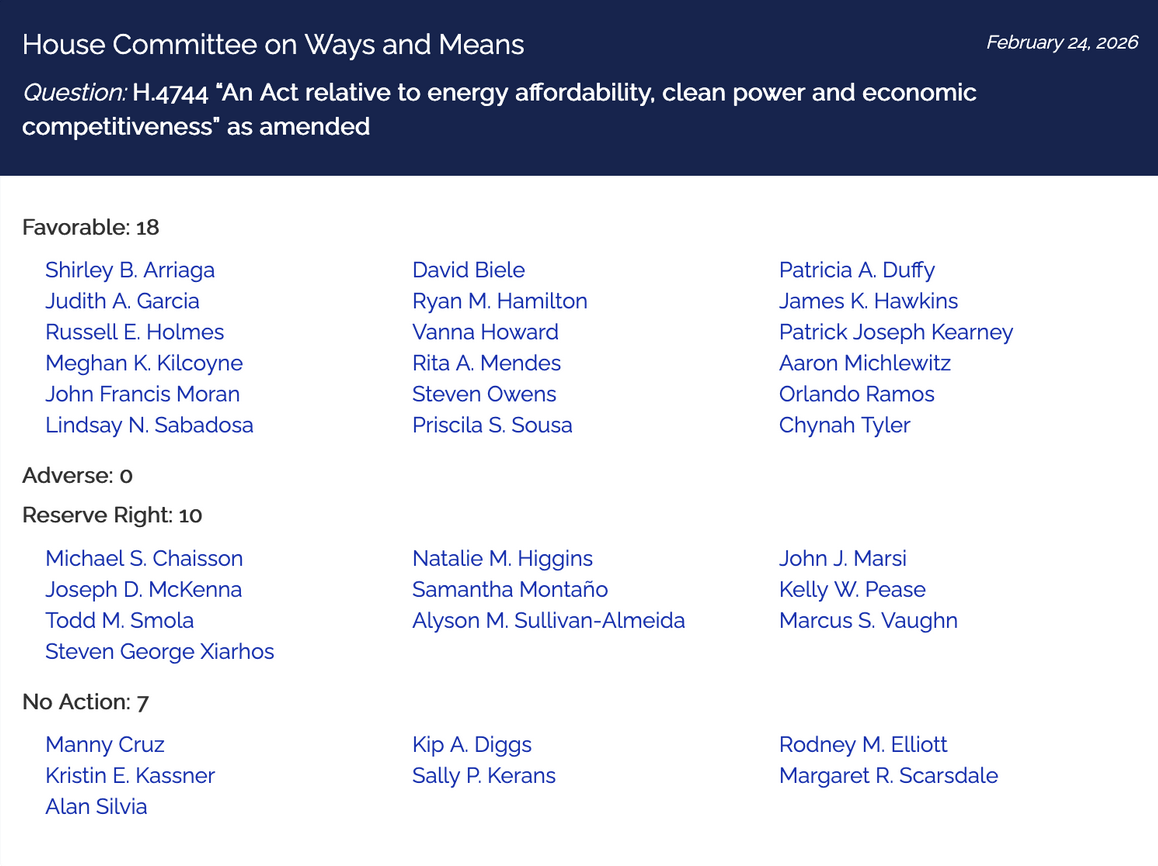
Progressive Representatives Sam Montaño and Natalie Higgins took a risk to reserve right and tell leadership this bill and process don’t work. Many legislators on House TUE and Ways and Means were told that if they support the bill moving out of committee, their amendments would be incorporated into the final bill. For the most part, that didn't happen.
Our Response
On Tuesday and Wednesday, February 24 and 25, advocates and organizers from across our movement joined legislators in the speed reading competition. Our 350 Mass Statewide Legislative Team and Save Money with Clean Heat campaign acted on plans laid out over the last few weeks to have our Bill Reading Team divide up the bill by sections and analyze it. We were in close contact with our allies, including Mass Power Forward, Gas Transition Allies, Green Energy Consumer Alliance, the Acadia Center, and more to identify the good and bad sections of the bill.
Our first glance identified many of the good changes made from November's bill:
- No changes to the 2030 climate goals (a major win!)
- Low/Moderate income rate protections maintained from the Mass Save 2025-2027 plan (although onerous means testing measures were added)
- Positive regulations around labor and network geothermal clean heat generation
But there was a massive issue. The bill called for a $1 billion cut in the Mass Save budget by 2027 - gutting the current three year plan in its final year. With a three year budget of $4.5 billion, or ~$1.5 billion a year, that makes this cut equal to about 2/3 of the final year’s budget of the 2025-2027 Plan. The bill authors claim to target marketing and administration costs, but there aren't $1 billion of marketing and administration to cut! The bill does not call for cutting utility spending on anything around fossil fuels, just cutting what Mass Save does to save ratepayers money. This comes just as the latest Mass Save plan represents major strides to better serve low income and Environmental Justice communities who had not been able to easily access it in the past.
Bad and omitted provisions include:
- Nothing to cut utility spending on lobbying, executive salaries, or perks, which would immediately save ratepayers money
- Nothing to cut GSEP (Gas System Enhancement Plan), when massive expenditures on gas infrastructure are one of the biggest drivers of high energy bills
- No addition of the Climate Bank, which would offer affordable financing for all
Once the initial analysis was done, we could dive into the next steps: amendments, mobilizing our network, and the actual vote on the bill!
Amendments, Rally, and Vote-a-rama
After many emails, calls, and zooms, we came up with our list of amendments we wanted to see in the bill, both to support and oppose. Our core message to legislators and the public was focused on the absurd nature of the "affordability" bill: We can’t cut energy efficiency programs that save people money! We need to cut wasteful spending on fossil fuel infrastructure, utility advertising, and executive salaries.
Our supported amendments covered many of the issues identified above: stopping Mass Save cuts, limiting GSEP (Gas System Enhancement Plan) expenditures, reducing utility lobbying and profiteering with ratepayer funds, and expanding the Climate Bank. We also opposed many that would bring back some of the worst elements of November’s Climate Rollback bill, including a gas pipeline tax paid for by electric customers and efforts to weaken the climate goals. You can see the full list of amendments here.
Once our list was ready, we activated our network to contact their representatives. Nearly 500 wrote through just the Mass Power Action Network letter in support of our coalition priorities, in addition to many sending our list directly to legislators.
Advocates wrote, called, then rallied! Over 100 from 350 Mass, Mass Power Forward, and allied groups gathered at the State House on Thursday, February 26. We sang and chanted right outside the Democratic Caucus meeting where leadership was whipping votes, with our “SAVE MASS SAVE” chants perfectly coinciding with speeches advocating for the cuts. Note the advocates dressed up as utility executives in the front row, gleefully thanking legislators for padding their profits!
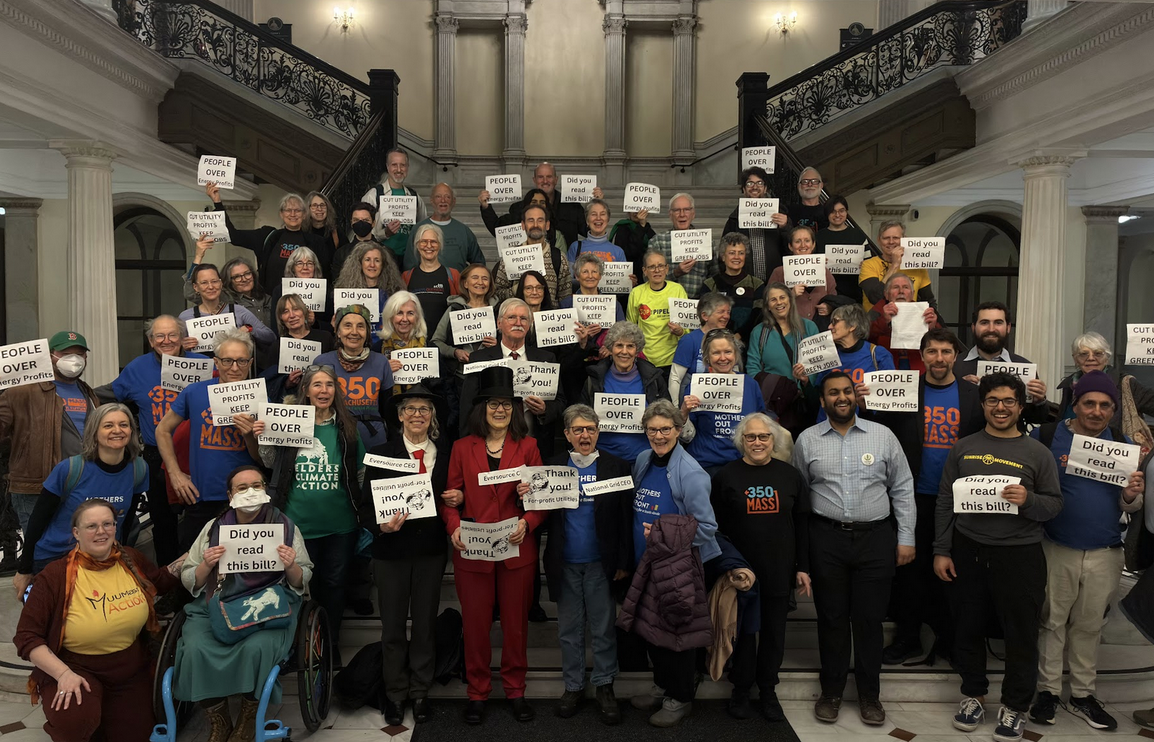
After the caucus we went to the House gallery to watch the political theater at work.
Stopping the $1 billion Mass Save cuts was represented largely by 2 amendments, #70 from Rep. Decker and #113 from Rep. Uyterhoeven. The first would have limited the cuts to around ~$130 million, while the second would have done away with them entirely. While #70 was unfortunately “consolidated away” into a consolidated amendment, #113 was surprisingly brought forward for a roll call vote.
{Note: What does “Consolidated Away” mean?
Most amendments were consolidated into three giant ones: A, B, and C. Leadership uses this process to remove amendments without recorded votes on specific ones. The numbered amendments listed at the top of the text are replaced with the policy written below. While some, like our endorsed amendment #6 around powering data centers with renewables, were included in the bill through this process, the vast majority were killed. While legislators can remove their amendments from the consolidated packages, they often face retaliation for doing so.}
Rep. Uyterhoeven took this opportunity for a roll call to get every Representative on the record whether they supported or opposed the Mass Save cut. In the end, 17 voted to keep the funding while 137 voted for the cut. If you approve or disapprove of how your legislator voted, let them know!
After working through a couple more amendments, the final bill was brought forward for a vote. Only two democrats broke party lines: Rep. Connolly (who also voted for Amendment #113) and Rep. Uyterhoeven. While it contained many good provisions we have fought for, these are tough to weigh in comparison to the program-breaking level of cuts to Mass Save. These cuts come as the program has finally started to deeply reach low income communities and communities of color. They imperil the 76,000 jobs supported by Mass Save. They hurt our ability to transition off of dirty, expensive fossil fuels.
Despite that, good things in the final bill include:
- Climate Goals: 2030 climate goals are still in place
- Solar: 20 GW of wind and solar on the grid by 2040
- Solar: A higher (20 MW) cap on municipal solar, which enables more school solar.
- Solar: Automated permitting for residential rooftop solar, with no interconnection agreement required, at a 70% discount to Investor Owned Utilities (IOUs, like Eversource and National Grid).
- Storage: V2G (Vehicle to Grid connections) with no interconnection agreement required, allowing the grid to use energy stored in electric vehicles rather than peaker plants when the load on the grid is heavy.
- Energy Justice: Banning predatory third party competitive electricity suppliers from targeting low income households
- Financing: Inclusive Utility Investing, which while not as cheap as the Climate Bank is very convenient for residents
- Data Centers: Good provisions on data centers requiring 80% renewables which will force the addition of solar, wind and batteries
- Municipal Light Plants (MLPs): A study of the first MLP in 100 years for Fitchburg. MLP’s charge residents as low as half the cost for energy as IOU’s
{Note: Energy policy is confusing! Please reach out to our Legislative Manager Dan Zackin with any questions at [email protected].}
For the full recording of the public parts of the proceedings, click here.
What’s Next?
After three months of planning, the House rushed a complicated and lengthy legislative package through in just three days. This was bad process and it intentionally hurt the ability of communities and advocates to influence the outcome. While the final bill included great strides toward our goals, it was clear that some legislators are still not up to speed on our plan for a just transition to clean, affordable energy.
Our plan includes:
- Short term: Cut misuse of ratepayer funds around lobbying, perks, and executive salaries, and rapidly wind down wasteful gas infrastructure spending under GSEP (Gas System Enhancement Plan)
- Middle term: Add solar and storage to Mass Save, while expanding the climate bank to finance renewable energy for more of the state.
- Long term: Decarbonize the grid to unhook us from volatile gas prices and build home grown, clean, affordable energy!
Now that the House has passed their bill, the Senate will take it up. After the Senate moves the bill through the Telecommunications, Utilities, and Energy Committee (TUE), it will go to Senate Ways and Means followed by an amendment fight and floor vote. This process may start as soon as April or May. The final Senate Bill will be reconciled with the House Bill in a conference committee, likely this summer.
The Senate will face similar pressures as the House to cave to greedy utilities and blame energy efficiency programs for high bills. We need to educate them, hold them accountable, and help them pass a strong bill.
Sign up for updates below and get involved in the fight!
Sign up for updates
Do you like this page?