

Massachusetts is facing a pivotal moment in its energy affordability journey. As conversations intensify around a proposed $1 billion cut to the Mass Save program, it is essential to pause and examine what is truly at stake—especially for the low-income households, renters, and communities of color who have historically been left behind in energy policy.
Drawing on work with renters and affordable-housing residents in communities like Lowell, Roxbury, Dorchester, and Mattapan, and from years of engagement in the Commonwealth’s energy-equity regulatory process, the implications of these cuts are unmistakable: they would dismantle the justice framework established in 2022 and weaken the only accountability mechanism we have for utilities.
What the $1 Billion Cut Would Undo
The 2025–2027 Mass Save plan includes a $1.78 billion equity commitment, the strongest in state history:
- $1.3 billion dedicated to low- and moderate-income households
- Over $600 million for renters
- $24 million annually for workforce development
These investments are not symbolic. They are the financial “teeth” behind the Performance Incentive Mechanism (PIM)—the tool that ties 50% of utility performance incentives to equity outcomes. Without this funding, utilities are effectively relieved of their binding equity mandates. The consequences are not abstract. They will be immediate, measurable, and deeply felt.
A Moment That Requires Discernment, Not Pressure
In Scripture, King Saul lost credibility because he acted under pressure rather than exercising discernment. That story resonates today. Legislative pressure is real, but decisions made in haste risk eroding the trust communities have placed in their leaders. The speed of the recent House vote made it difficult for residents to understand the implications. The Senate now has the opportunity—and responsibility—to pause and consider the long-term impact.
For many renters, the projected $7-12 reduction in energy costs from energy efficiency is both minimal and uncertain. Because Massachusetts relies heavily on natural gas for electricity generation, market volatility and distribution rate cases will likely erase any short-term savings and increase future costs. What is being framed as “affordability” may ultimately deepen the burden.
What the Data Shows: Equity Tools Are Working
1. Demand in Low-Income Programs Is Surging as shown in the February 2026 EEAC meeting EEAC Low-Income Update (Feb 2026)
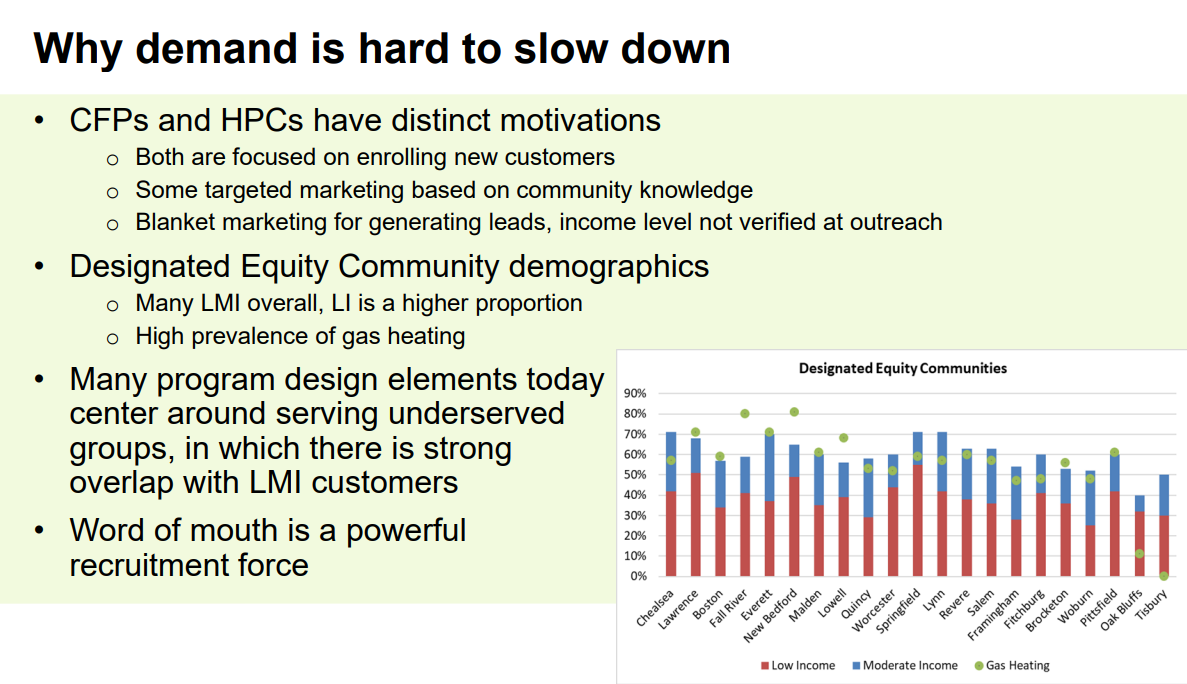
Recent EEAC updates show:
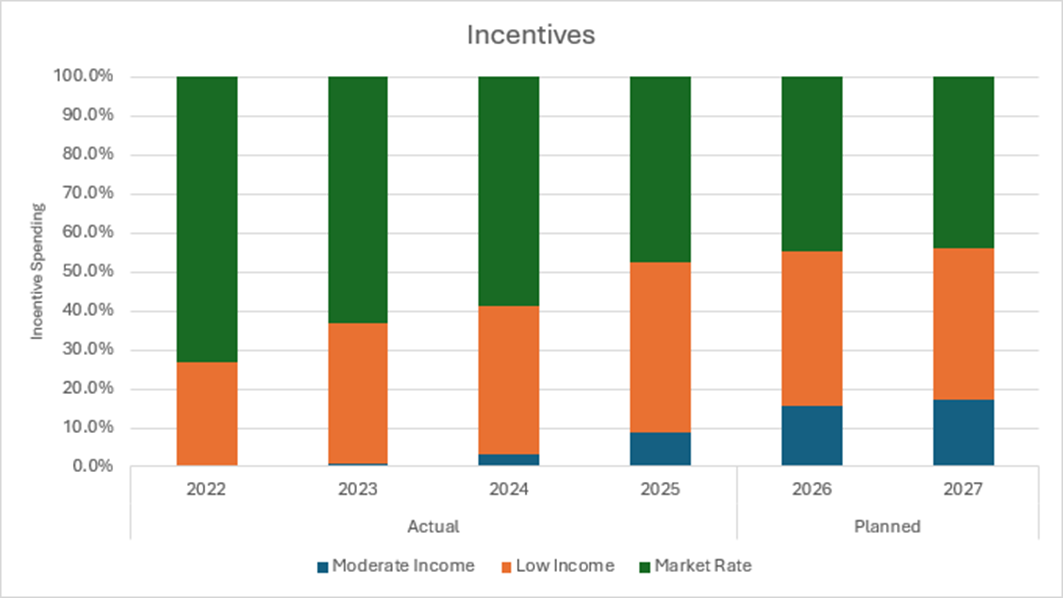
- 2025 was the first year LMI incentives exceeded market-rate incentives, reaching 53% (up from under 30% in 2022).
- Electric participation in Hard-to-Reach communities increased from 29% to 36%.
- 98% of HTR municipalities saw increased participation, and 20% rose above the statewide average.
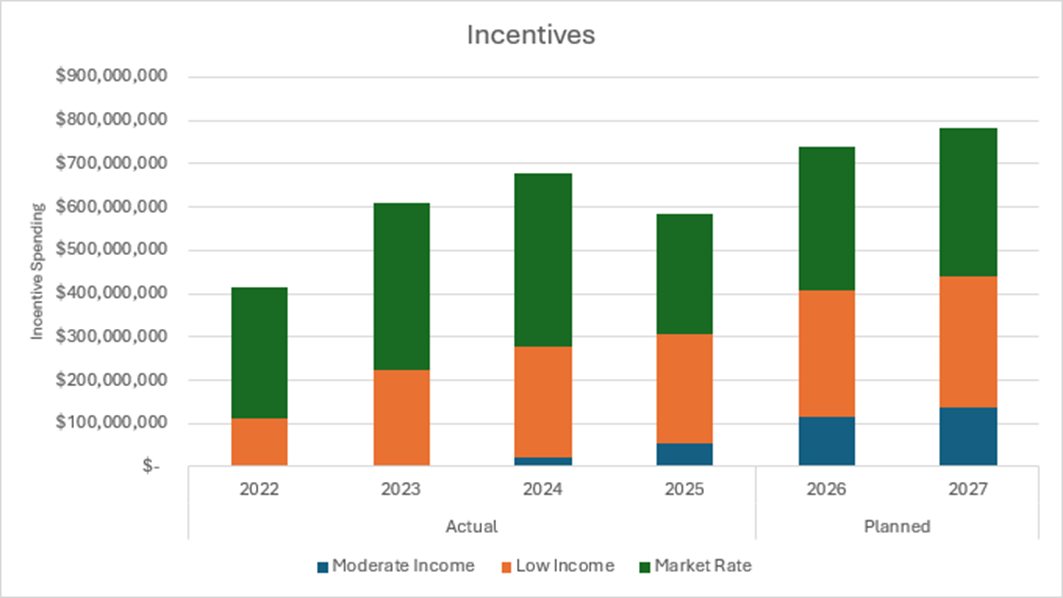
These gains are the direct result of targeted equity investments—not budget cuts.
2. The PIM Is the Only Tool Holding Utilities Accountable
No other clean-energy program in Massachusetts has equity mandates. The PIM, adopted in 2022 after a decade of advocacy, includes goals such as:
- Weatherizing 69,000 low-income homes
- Upgrading 49,000 rental units
- Installing 20,000+ heat pumps in the low-income sector
- Meeting language-access and distributive-justice benchmarks
- Ensuring 15% of contracts go to MWBEs, strengthening local Black and Brown workforce pipelines
- Reforming background-check processes to open pathways for justice-involved individuals
- Funding community energy advocates in cities like Lowell
- Supporting disadvantaged schools through the $47M TESI initiative
These are not optional programs—they are the backbone of equitable decarbonization.
3. Low-Income Spending Has Been Rising, Not Falling
- 2019–2021: $336M (12.3% of total spending)
- 2022–2024: $740M (22% of total spending)
- 2025–2027 plan: $1.17B (26% of total spending)
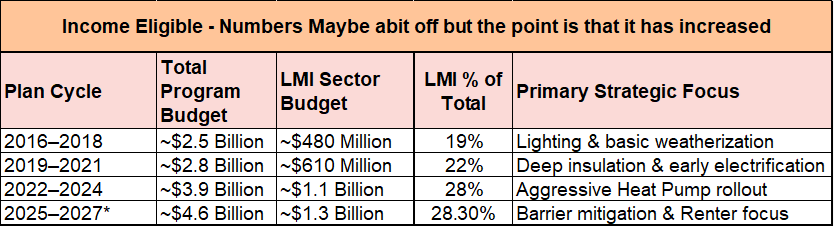
A $1 billion cut would reverse the current trajectory and exacerbate already long waiting lists. It is important to note that low- to moderate-income (LMI) spending in 2025 is projected to be higher than during the 2010-2012 term. As shown in the graph below, from 2019 to 2021, spending on low-income initiatives was $336,685,239, which accounted for 12.3% of overall spending. From 2022 to 2024, this spending increased to $740,750,150, making up 22% of overall spending. For the 2025-2027 plan, spending is planned to reach $1,176,480,121, representing 26% of overall spending.
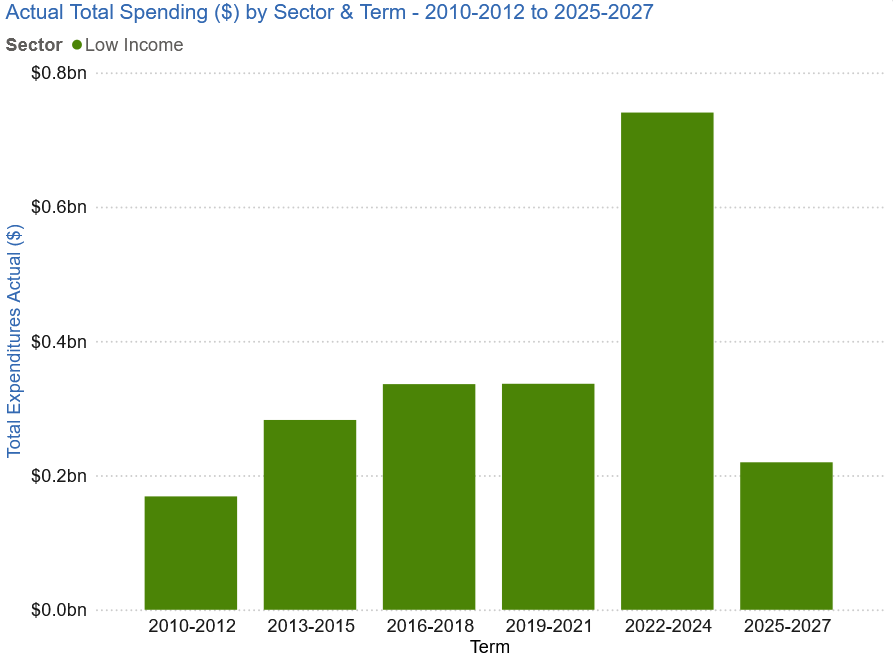
Note: This is spending in the low-income sector. The last sector looks smaller than it is because its just 2026 and the data is a bit lagging. From 2019-2021, low-income spending was $336,685,239 (12.3% of overall spending). From 2022-2024 spending increased to $740,750,150 (22% of overall spending). For the 2025-2027 plan, spending is planned to be $1,176,480,121 (26% of overall spending).
4. The “Savings” Narrative Does Not Hold for Low-Income Households
Many low-income households benefit from discount rates. Budget cuts do not reduce their bills. What truly lowers their 6%–15% energy burden are Weatherization, Electrification, heat pumps, air sealing, and efficient appliances. These are exactly the measures that would face cuts.
5. Section 7 of the House Bill (H.5151) Would Gut Additional Equity Programs
Returning 70% of ACP revenue to ratepayers for minimal, if any, benefit would undermine the Affordable Housing Decarbonization Technical Assistance, Solar for All matching funds, Affordable Housing Decarbonization Grants, and Low-Income Solar Support programs. These programs provide significant, long-lasting benefits rather than just temporary bill credits.
6. True affordability requires structural reform. Long-term affordability will not be achieved by cutting equity programs, but by addressing:
- Utility Return on Equity
- The Gas System Enhancement Program
- The utility business model itself
Equity tools are not the problem—they are the solution.
A Call for Discernment and Care
This moment demands clarity, humility, and a commitment to the communities most affected. The Commonwealth has made historic progress in returning ratepayer dollars to the households that need them most. Rolling back $1 billion in equity funding would not create energy affordability; it would erase it. The question now is whether Massachusetts will protect the tools that are finally working or dismantle them under pressure.
Other Resources for Policymakers and Community Leaders
- Mass Save Equity Targets
- Equity Report during the 2022-2024 term 2022 Q3 Results
- Dedicated equity working group with resources on the EEAC website
- Designated Equity Communities (DECs): 21 communities prioritized for distributive justice for renters.
- Distributive Justice in Mass Save: Context on the 2024 policy shifts.
- Mass Save Data Portal: Real-time transparency on municipal-level spending.
These resources offer a clear picture of how equity is being operationalized—and what would be lost if funding is withdrawn.
Acronyms
ACP:Alternative Compliance Payments
CFP: Community First Partner
EEAC: Energy Efficiency Advisory Council
HPC: Home Performance Contractors
LMI: Low/Moderate Income
MWBE: Minority- and Women-Owned Business Enterprises
PIM: Performance Incentive Mechanism
TESI: Transforming Energy in Schools Initiative
Mary Wambui is a Lowell Resident and Residential Consumers Councilor at the EEAC.
Sign up for updates
Do you like this page?