

Today’s blog post features an interview with Larry Stoodt, a longtime active member of 350 Mass who led the charge for 350 Mass at this year’s 2025 Democratic Party State Convention on Saturday, 9/13. Our interview aims to answer an important question: what happened at the state convention, and what does it mean for the Make Polluters Pay campaign?
– Olivier Bradley, Better Future Project, Communications Fellow
Name: Larry Stoodt
Town: Framingham, MA
Node / Working Group(s) / Other Civic Involvements: 350 Mass MetroWest Node, State Legislative Team, State Executive Team, Sustainable Framingham, Local Democratic Committee (Officer)
About how long have you been involved?: Long enough not to remember . . .
What happened at the 2025 Democratic State Convention?
Well I think ‘what happened’ starts before the convention. I had been pushing 350 Mass to get involved in the convention on the issue of Make Polluters Pay—I had stated my opinion that there were supposed to be 3800 delegates going to the convention that are generally active in their Local Democratic Parties, and I thought it was a great place to celebrate and present Make Polluters Pay to the convention. We wound up with a loose coalition of 350 Mass, Our Revolution Massachusetts, elements of the Mass Power Forward coalition, and Sunrise working together to present a plank to the platform. That group was also involved in organizing what I like to call “the rebellion”.
What was “the rebellion”?
The state Democratic Party had deleted many of their platform’s key commitments, reducing a 70-page platform to about 24. In response, the rank and file of the Democratic Party rose up and struck that down.
We presented a friendly amendment with language that supported Make Polluters Pay, which was also adopted. There was a lot of organizing done—we collected quite a few petition signatures and passed out 1000 different quarter sheets explaining routes to get involved with passing this bill [H.1014].
Offering additional context here for our readers—the push to restore the 2021 “People’s Platform” was led and backed by Our Revolution Massachusetts (ORMA), Bay State Stonewall Democrats, Massachusetts Campaign for Single Payer Health Care (MassCARE), Massachusetts Peace Action (MAPA), Massachusetts Progressive Action Organizing Committee, Progressive Democrats of America (PDA), Progressive Mass (PM), and Voter Choice MA. This broad coalition of party progressives, grassroots activists, and passionate delegates fought to defend hard-won components of the 2021 platform—including commitments around prevention of local police from cooperating with federal immigration officials on civil immigration enforcement, progressive taxation, single-payer healthcare, and voting reforms (e.g., same-day registration and instant runoff voting).
– Olivier
How did collecting signatures go? What challenge did groups proposing amendments run into?
We had volunteers collecting signatures as soon as breakfast started at 8 AM—groups proposing amendments had from 8 until 10 AM to collect 500 delegate signatures and to submit those. After that, volunteers went around to the floor sections for each of their Senate districts, which was how the seating was split up. We also had a table upstairs which acted as our “campaign central”. And before delegates voted on the amendment, we had volunteers passing around Make Polluters Pay information sheets, which helped us to get people up to speed and on board.
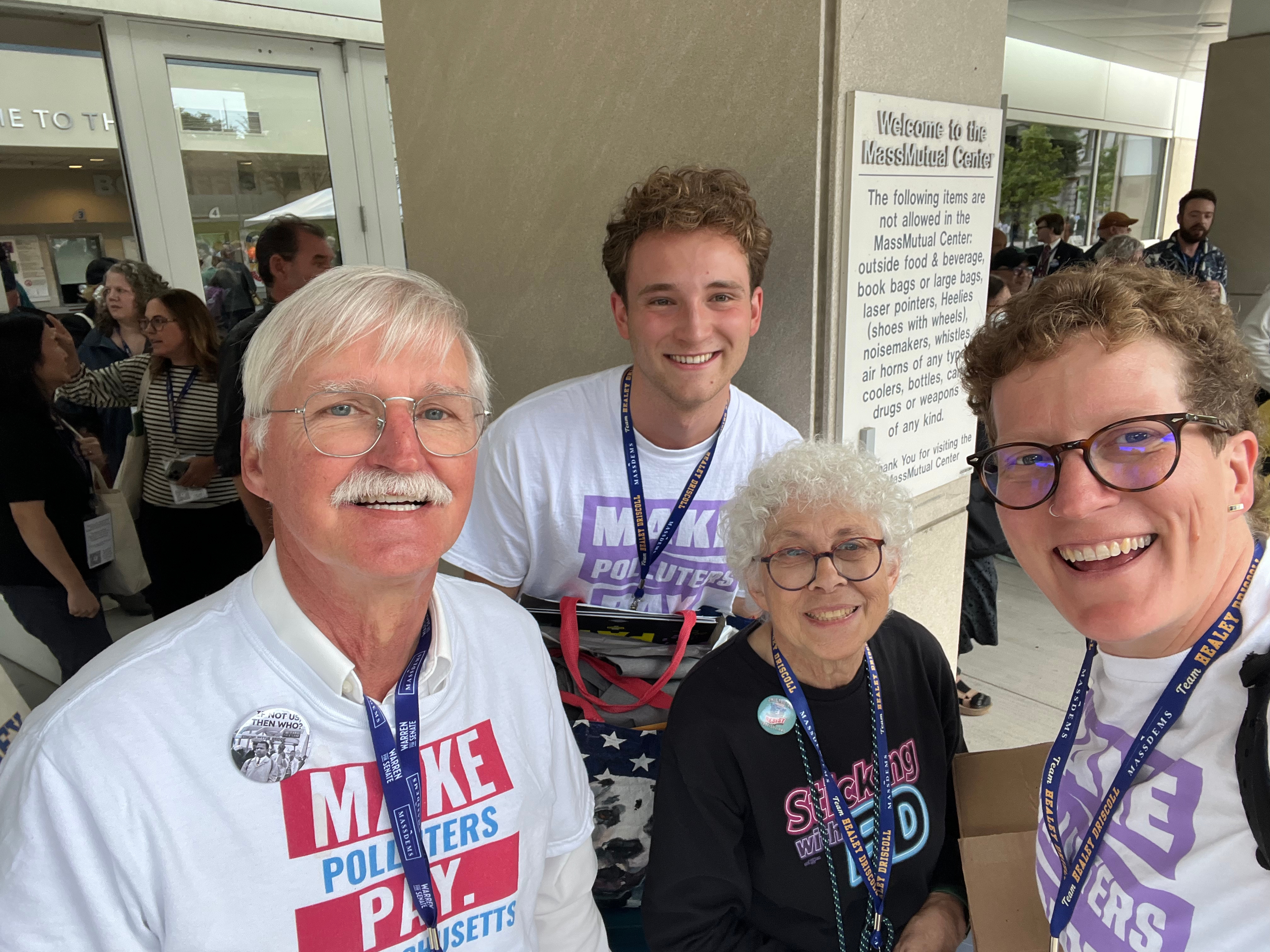
The breaking point was when convention leadership announced that three of the five amendments presented would not be considered, because we had not made paper copies available for every delegate to look at before voting. Leadership had not done their job and communicated this part about the copies to groups putting forward amendments, which got people mad enough that they successfully motioned leadership to suspend the rules and consider all five amendments. I’ve been to a few of these conventions—and this time was more active than I had ever seen it before.
“I’ve been to a few of these conventions—and this time was more active than I had ever seen it before.”
Yeah. That was my first time and it was really cool to see—pretty inspiring. Moving on, maybe you could give our readers some quick context around the state convention—what is it, and why does it matter? Why does getting Make Polluters Pay on the Democratic platform matter?
Okay. There are two types of conventions. One is a nominating convention which will come up soon, and the other is a platform convention or an “issues convention”, which is what we had this year. Why does that matter? I’d say since the Democratic Party doesn’t necessarily follow its own platform—which I can prove by Maura Healey just signing off on bringing more pipelines to the state when that’s a definite violation of the platform—the bottom line is that this is an attempt to bring a certain amount of levelness in the positions of the Democratic Party . . . [it’s] more educational than practical at times. This platform committee, the reason that I think it’s important is that we got to educate a whole bunch of members of the Democratic Party, and these are active people—I mean, you don’t just get elected to go to the convention without either being very active in your Local Democratic Committee, or being connected and active in areas around, but you have to be a Democrat. So that’s the educational part of it. And it gives organizers [like myself, a tool so that] I can point to this and say “you’re doing this and this, we need you not to do this” or “please do this, because in the Democratic platform carried forward by the convention it says that we should do this”.
To tie this back into Make Polluters Pay, what would you say are the biggest benefits of getting Make Polluters Pay on the platform?
It gives us an organizing tool to work with. Consider the body in the legislature that we need to deal with—the Joint Committee on Environment and Natural Resources—we have a direct tie into some of those districts and now we can leverage this new development to continue our education and advocacy push for the climate superfund bill. For example, I live in Senator Karen Spilka’s district, so now I have a tool to go to the other Local Democratic Committees in her district and say “the Democratic platform convention has passed this language—can you pass a resolution in your committee to support this?”. I also intend to take this language to the Framingham City Council and ask them to pass a resolution in support of this. So, building momentum off of the ground in the state Democratic Party is one method of working on this; it’s not the only method, but it’s one method of working on this. And it’s a good tool.
What was different about this year’s convention specifically compared to past conventions?
First of all, one of the more important votes came before the discussion of the platform. Party leadership tried to make a charter change that would’ve basically eliminated one of the two conventions. And—this is my opinion, not 350’s—that was an attempt to block the grassroots kind of action that actually took place in this convention; the ability to organize. When you get to a nominating convention, it’s about the candidates; the convention is all about who’s going to run for Senate and about who gets the endorsement for state offices. So, stuffing those together would have created a situation where issues would not have been paid attention to on the level that they need to be. And I think that that was one of the most important things that happened in this convention.
The other thing that happened differently in this convention is that democracy broke out on the floor of the Democratic Party. And it was chaotic and messy just like democracy can be. Even the chair of the party, Steve Kerrigan, had to recognize the fact that the citizens that are involved as delegates had expressed themselves . . . and that was a good thing. The bottom line is that the grassroots—the floor of the convention—determines how the state Democratic Party proceeds, and that’s how it’s supposed to be. The fact that they had to break the proposals brought forward to them to do it is a little disconcerting, to say the least . . . putting that mildly.
“[this year] democracy broke out on the floor of the Democratic Party . . . and that’s how it’s supposed to be.”
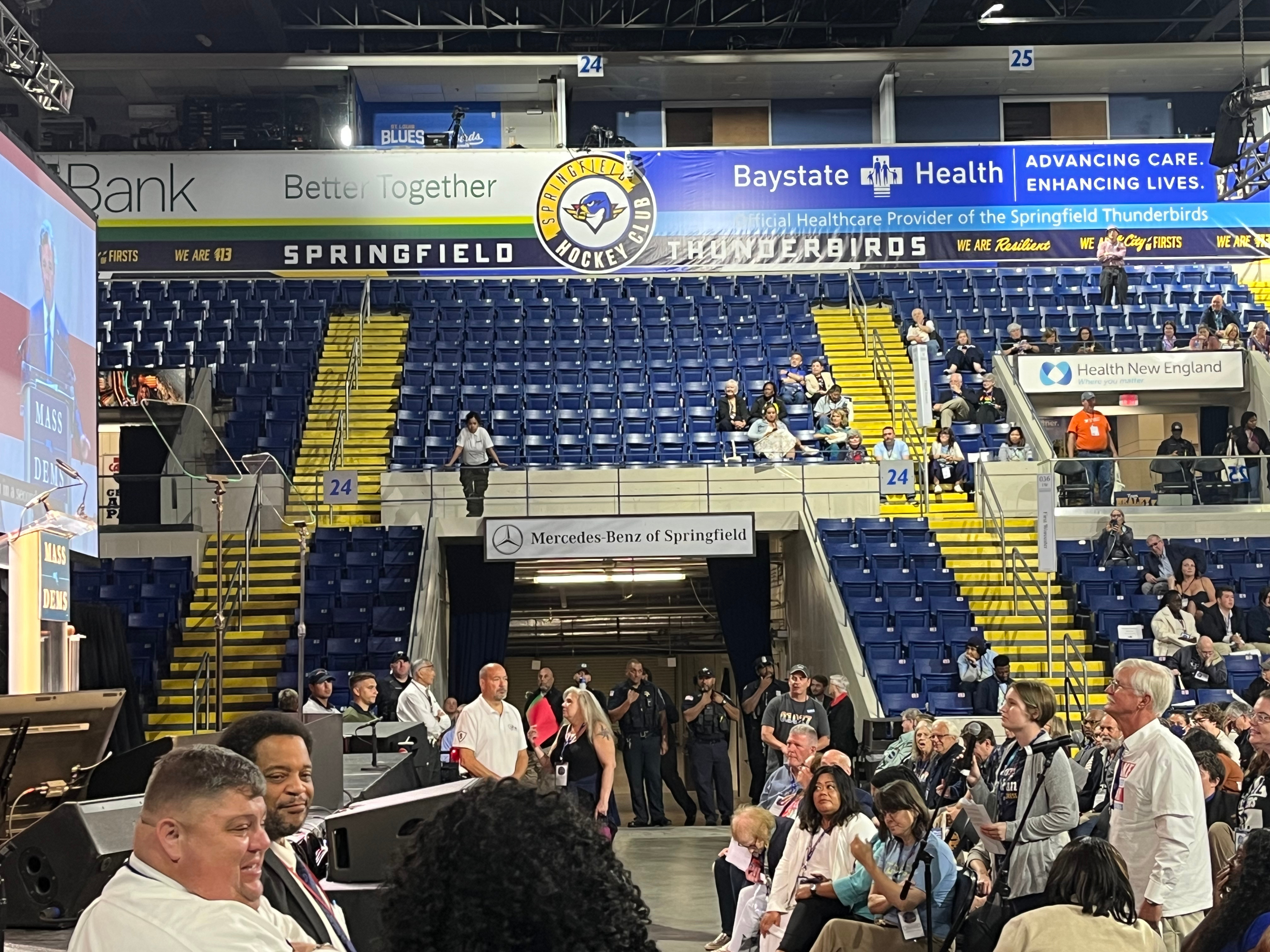
Yeah, agreed. It was also definitely inspiring, though, to see everyone resisting what they felt to be unfair and against the state Democratic Party’s stated values. I thought that was hopeful, at least. Where do we go from here? Would you say the happenings at the convention signal anything for the state of the climate justice movement and broader movements for social change writ large?
I just have to say that the fact that the environmental movement was so active on the floor of the convention was necessary, absolutely necessary in my opinion, and the fact that a grouping of progressive and other issue groups got together and made sure that the convention reflected the progressive values that were in the 2021 [People’s Platform] is a good starting point for organizing a lot of different issues. We need to make sure that we reach out to these Senate districts and try to organize ground-up, just as the convention was. We need to stand up for our environmental rights, and our political rights, for that matter.
On the governmental side I’m very concerned with what’s going on. From the floor of the convention it was positive, but I’m not sure the state government is moving in the same direction. We can’t take this out of the context of what’s going on in the country—the fight against authoritarianism is a critical part of the environmental movement, and we have to figure out how to integrate ourselves in that while not losing focus on the struggle for saving the environment and the planet. I think that’s where the convention could play a springboard role, because like I said there were supposed to be 3800 at the convention and those are the active people and they need to make sure they take the message back to the ground-level things. I have the great advantage of living in MetroWest, where we have four state reps and the Senate President Karen Spilka representing us, three of whom have endorsed Making Polluters Pay. We will continue to organize in the Senate districts as well. There is a working group being formed around resisting authoritarianism and parsing out where the environmental movement fits into it—and I hope other people that were involved in this can take part [in that discernment process, whether in that specific working group or in that general social conversation].
Yeah, I think you hit the nail on the head. Movements for justice are intertwined in so many ways—both in underlying structural root causes and in solutions, to some degree. We need to build coalitions and find commonalities across movements for social change. And like you said, we also cannot lose sight of our environmental and planetary focus. Any parting comments for our readership?
Just one expression: if you are reading this, then please sign up for Make Polluters Pay, or Save Money with Clean Heat, and your Local Democratic Party. If you’re not a member of your Local [or the] Democratic Party then get involved with local groups like Indivisible or 50501, and bring our issues in front of them, and—have fun organizing.
Thanks Larry!
Note: This interview has been lightly edited for clarity.